AI robotic arms work by combining advanced mechanics—similar to a human arm—with artificial intelligence, which allows them to perceive their environment, make decisions, and learn from data. Whereas traditional robotic arms follow rigid, pre-programmed paths, the latest AI-powered arms use sensors and machine learning to adapt to new, unstructured tasks autonomously.
Quick Thoughts About Innovations in AI Robotic Arms
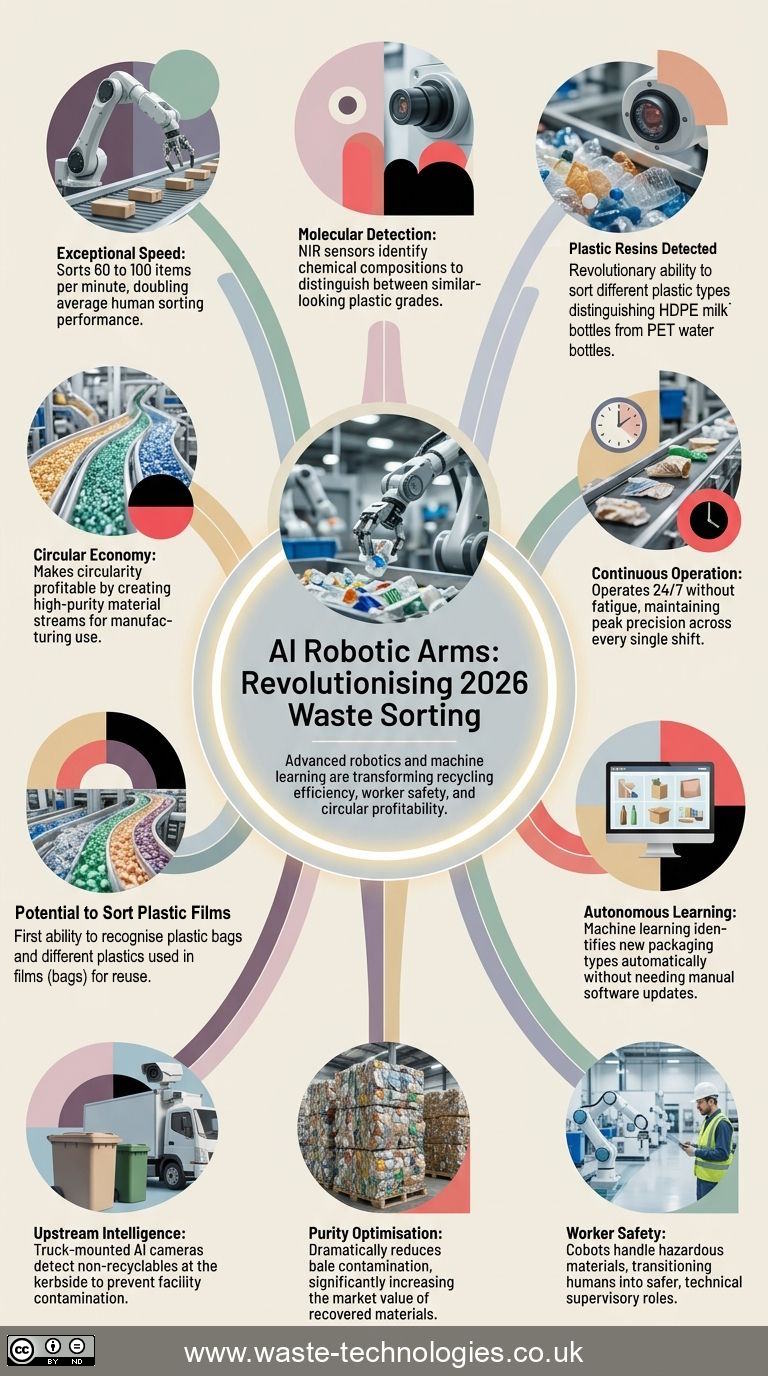
- AI robotic arms can sort 60 to 100 items per minute — far outpacing the speed and consistency of any human sorter on a recycling line.
- Machine learning allows these systems to adapt to new packaging types and materials automatically, meaning they get smarter with every shift they run.
- Modern Materials Recovery Facilities (MRFs) are going fully automated, with some plants operating 24/7 with minimal human intervention — a glimpse into what recycling infrastructure looks like in 2026.
- AI optical sensors can distinguish between plastic grades like Plastic #1 (PET) and Plastic #7 (mixed/other) — a level of material-level detection that the human eye simply cannot match at conveyor speed.
- The shift isn't about replacing workers entirely — collaborative robots (cobots) are redesigning human roles toward oversight, maintenance, and quality control rather than hazardous manual picking.
The recycling industry has a dirty secret — the majority of what people toss into their blue bins never actually gets recycled, and for decades, slow and inconsistent manual sorting was the bottleneck nobody wanted to talk about.
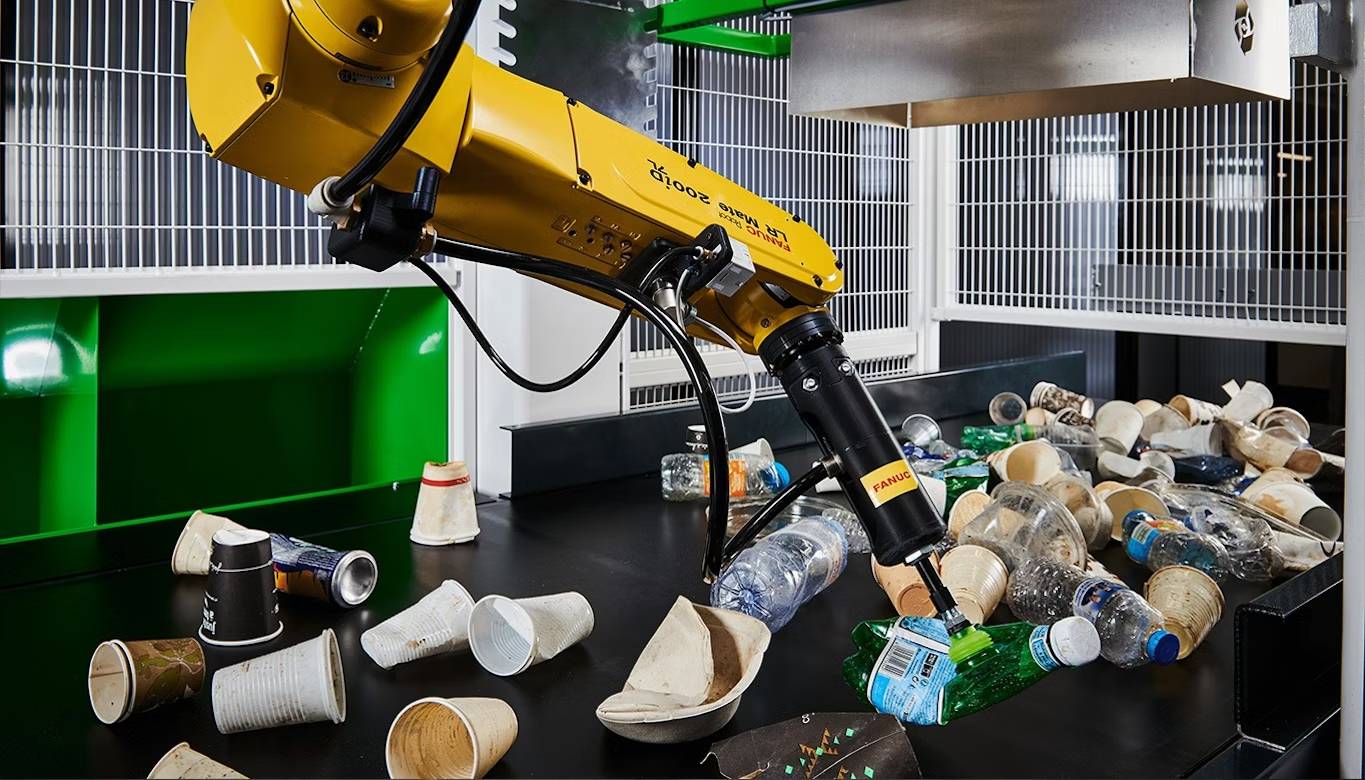
“Recorra buys AI sorting arm in £1m MRF …” from www.letsrecycle.com and used with no modifications.
There is a rapid shift in the way waste is sorted. AI-controlled robotic arms are now being used in Materials Recovery Facilities all over the United States and other parts of the world. They sort plastic, paper, metal, and glass at a pace that would have been unthinkable a decade ago. Plasticmakers.org has been monitoring how these combined robotic systems are improving U.S. circular supply chains and reducing the amount of recyclable material that ends up in landfills. The data is quite convincing.
Robots Are Now Sorting Trash More Efficiently Than Any Human Ever Could
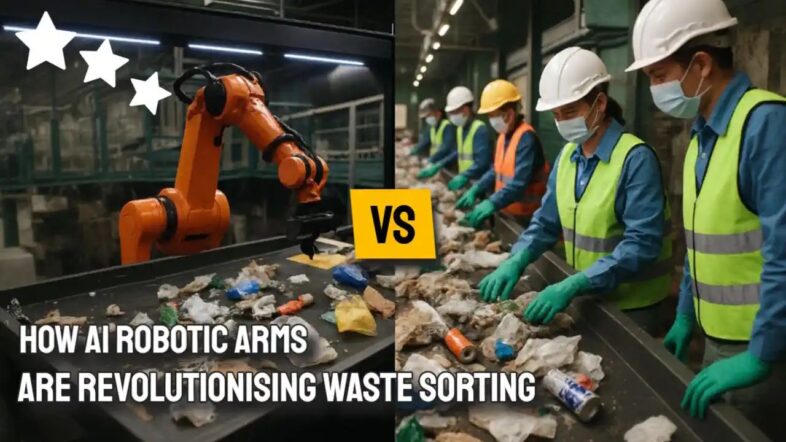
Imagine a conveyor belt that never stops moving, carrying mixed recyclables — smashed plastic bottles, cardboard, aluminum cans, broken glass, and dirty food packaging all mixed up. A human sorter on that same line can realistically identify and remove materials accurately for a few hours before they get tired and start making mistakes. An AI robotic arm doesn't get tired. It doesn't blink. And it works at 60 to 100 picks per minute, consistently, for an entire shift or even 24 hours without stopping.
The benefits of this speed increase go beyond mere statistics – it completely alters what a recycling plant can recuperate. When throughput rises, and precision remains consistent, more recyclable material is collected before it reaches the residual waste stream destined for the landfill. That's the practical effect behind the data.
What Happens Behind the Scenes in a Recycling Facility with AI Robotic Arms
There's a lot more to an AI robotic sorting arm than meets the eye. It's not just one machine doing all the work, but rather a series of systems that work together in perfect harmony. It's a quick process that involves sensing, processing, decision-making, and taking action, all in the blink of an eye.
- High-resolution optical cameras mounted above the conveyor belt capture continuous image data of incoming material.
- Near-infrared (NIR) sensors detect the molecular composition of materials, identifying plastic types, paper grades, and organic contamination.
- An AI processing unit runs machine learning models that classify each item by material type, size, and position in real time.
- A robotic arm with a pneumatic suction gripper receives precise coordinates and picks the target item with accuracy measured in millimetres.
- The sorted item is deposited into the correct output chute or bin, completing the cycle in under a second.
Each of these stages happens simultaneously across multiple robotic units positioned along the same conveyor line, creating a layered sorting process where different robots are each trained to prioritise specific material categories.
Optical Sensors and Cameras: The System's Vision
The optical layer is the starting point. The system's “material vision” is far superior to human vision thanks to high-resolution cameras and NIR spectroscopy. NIR sensors operate by reflecting light off materials and reading the reflected wavelength. Different polymers and material types reflect light differently, which gives the system a unique spectral fingerprint for each item. This is how a robotic sorter can distinguish between a clear PET water bottle and a clear PVC container that look the same to a person on the line.
Machine Learning: How the Robot Learns and Adapts
These AI models are trained on huge datasets of labelled material images and spectral readings. What's truly impressive about modern systems, however, is adaptive machine learning. This allows the system to update its classification models when new types of packaging enter the waste stream. If a brand launches a new multilayer flexible pouch or a unique compostable container, a traditional optical sorter would classify it incorrectly. An adaptive AI system, on the other hand, flags the anomaly, learns from it, and adjusts — often without needing manual reprogramming.
Breaking Down the Pick-and-Place Process
Once the AI has identified the target item and determined its position, speed, and trajectory on the moving belt, it sends coordinates to the robotic arm. Most systems use a delta-style robotic arm. This is a lightweight, high-speed parallel robot that is suspended above the conveyor. It is equipped with a pneumatic suction cup or a multi-fingered gripper. The arm swoops down, grabs the item, and places it into the correct output stream. All of this happens within a motion window of approximately 0.5 to 1 second. The level of precision required here is incredible. The system must take into account the belt's continuous movement and adjust the pick point dynamically. For more insights on how AI and robotics are modernising recycling, check out this article.
60 to 100 Items Per Minute: The Speed Advantage Over Manual Sorting
Modern AI robotic picking systems are built around and regularly achieve the 60 to 100 items-per-minute figure in live facility environments. This isn't a marketing claim, it's an operational benchmark. To put that in perspective, an experienced human sorter operating at peak performance can manage somewhere in the range of 30 to 40 picks per minute before accuracy starts dropping — and that's before accounting for break schedules, fatigue, and the psychological toll of working around hazardous waste materials all day.
Imagine a robotic arm that can sort 80 items per minute, working for 16 hours a day. That's 76,800 sorting decisions in just one day. Now, imagine a facility that has six or eight of these robotic arms working at the same time. The volume of work they can do is mind-boggling. And they make almost no mistakes, unlike human sorters who can be inconsistent.
Why Humans Are Not the Answer at This Scale
This isn't a knock on human workers — it's an acknowledgement of physical limitations. Manual sorting on a high-speed conveyor is physically demanding, repetitive, and carries genuine injury risk from sharp objects, biological hazards, and musculoskeletal strain. Occupational health studies have consistently identified MRF sorting lines as high-risk work environments. Human sorters also have difficulty identifying contamination at speed — a greasy pizza box looks just like clean cardboard to a tired eye at 11 PM on a night shift. Robotic systems don't have that problem.
The Role of High-Speed Sorting in Minimising Landfill Waste
When an item is incorrectly identified on a manual sorting line, it either ends up in a landfill when it could have been recycled or it contaminates a recycling bale and lowers its value. AI robotic systems can help to prevent both of these outcomes. With higher pick rates, more material is sorted instead of being left as residual waste. With higher accuracy, the quality of the bale is improved, which in turn increases the value of the recovered materials. This makes large-scale recycling more economically viable.
How AI Optical Sorters Differ from Conventional Conveyor Belt Sorting
Conventional conveyor belt sorting has always depended on a mix of physical separation technologies, like screens, magnets, and eddy current separators, along with human pickers to grab what the mechanical systems didn't catch. This method was sufficient for the bulk separation of general material categories, but it was never capable of the detailed, material-level identification that today's recycling markets require.
AI optical sorting has brought about a game-changing shift. Instead of sorting materials based solely on physical properties such as density or magnetism, AI systems can identify materials based on their molecular makeup and visual traits at the same time. The outcome is a sorting process that is not only quicker, but also much more precise.
How AI Optical Recognition Systems Can Detect What Humans Can't
AI optical recognition systems can identify material properties that humans can't see at conveyor belt speed. Near-infrared spectroscopy can identify the type of polymer a plastic item is made of in milliseconds, distinguishing PET from HDPE, PVC from PP, without touching the item. These systems can also identify items with dark colourants that older NIR systems used to miss, identify multilayer flexible packaging, and even detect moisture levels or organic contamination on a surface. This level of detail is impossible to achieve with manual inspection at industrial production speeds.
AI Implementation and Its Effect on Contamination Rates
Contamination has always been a major roadblock in recycling economics. A single contaminated bale can be rejected by a materials buyer, turning a potential source of income into a disposal cost. Facilities that have integrated AI optical sorting systems have reported measurable reductions in contamination rates across output bales. This is due to the more precise identification and rejection of non-conforming materials before they reach the baling stage.
AI systems greatly reduce plastic bale contamination by actively rejecting non-target polymers that physical screening may overlook.
When wet or food-soiled cardboard is flagged and diverted by optical sensors, the quality of paper bales is improved, rather than being mixed with clean fibre.
AI systems can distinguish between clear, brown, and green glass fractions, which results in an increase in glass recovery rates, rather than mixing them into a lower-value mixed cullet stream.
Metal separation becomes more precise when AI is combined with eddy current separators to capture small-format aluminium items that would otherwise be missed by mechanical systems.
The downstream effect of cleaner bales is significant. Commodity buyers are willing to pay premium prices for uncontaminated material streams, which means that the implementation of AI not only reduces the volume of landfill but also actively increases the revenue per tonne of recovered material for a facility.
Prior to the introduction of AI, many MRFs were dealing with contamination rates so high that it simply wasn't cost-effective to process certain materials. Some facilities were even sending mixed plastics straight to the landfill because the cost of manually sorting them was higher than the market value of the material they could recover. AI completely transforms that equation, as discussed in how AI and robotics are modernising U.S. recycling.
Nowadays, the numbers add up in a way they didn't before. When a robot can quickly and efficiently sort mixed plastics into specific polymer grades, the recovered material has real value as a commodity, instead of being a financial burden.
Why It's Important to Distinguish Between Plastic #1 and Plastic #7
Plastic #1, also known as PET (polyethylene terephthalate), is one of the most valuable and widely accepted recyclable materials in the world. It's the material most commonly used to make water and beverage bottles, and there's a strong global market for recovered PET. On the other hand, Plastic #7 is a catch-all category that includes everything from polycarbonate to multilayer bio-based materials. Most regions have little to no recycling market value for Plastic #7. The issue arises when a clear Plastic #7 container and a clear PET bottle are sitting side by side on a conveyor belt. They look virtually identical. This is where AI NIR systems come into play. They can distinguish between the two types of plastic in less than a millisecond. Without this level of material detection, valuable PET can end up mixed with worthless Plastic #7. This devalues the entire bale and undermines the economics of plastic recycling.
Robots and Humans Working Together
Robots don't always work alone in today's Material Recovery Facilities (MRF). Some robots, known as collaborative robots, or cobots, are designed to work in the same space as human workers. These robots combine the precision and stamina of machines with the judgement and adaptability of humans. In a recycling plant, this usually means that the cobot does the fast, repetitive picking on the main sorting line, while a human worker nearby handles exceptions, checks the quality, and deals with any items that the AI isn't sure about. This is a real partnership, not a replacement. In fact, this is how most facilities are using this technology today. To learn more about this, you can read about how AI and robotics are modernising U.S. recycling.
How Cobots Enhance Worker Safety in the Presence of Dangerous Materials
Recycling facilities deal with everything that people discard — this includes needles, shattered glass, containers with chemicals, and biologically contaminated materials. Manual sorters are directly exposed to these dangers every shift. Cobots take on the high-risk contact by taking care of the initial sorting on lines where hazardous items are most likely to show up. This moves human workers away from the direct stream of materials and into roles that supervise that involve much less physical risk. The outcome is a noticeable improvement in metrics for safety in the workplace without giving up sorting performance.
Transitioning from Physical Labour to Supervision and Maintenance
The common belief that robots are taking jobs away doesn't capture the full picture of what's happening in a modern MRF. As robotic arms take on the monotonous and physically taxing picking tasks, the roles of humans are changing to include robot supervision, system maintenance, AI model quality assurance, and facility management. These new roles require different skills, such as technical literacy, mechanical aptitude, and data interpretation, but they are safer, better paid, and more sustainable for long-term employment. Facilities that adopt this model are investing in retraining programs to prepare existing sorters for these new operational roles. For more insights on how technology is transforming waste management, read about the role of AI and robotics in the future of waste management.
Recycling Trucks and Collection Infrastructure Powered by AI
The AI revolution in waste management starts long before the garbage reaches the facility — it begins at the collection point. A new layer in the system is being formed by smart collection infrastructure, which gathers data about the composition of the waste before it even arrives at the sorting facility. This upstream data directly influences the operations at the facility, enabling the processing lines to be set up in advance for the actual incoming material mix instead of responding to it later.
By sharing real-time data between the collection infrastructure and facility sorting systems, the entire waste management chain can become more responsive and efficient. If there's a sudden increase in a specific material type in a collection zone, the sorting line configuration can be adjusted before the trucks even arrive. This level of proactive operational management just wasn't achievable with disconnected legacy systems.
AI in Route Optimisation
AI is helping to optimise waste collection routes by using real-time data from fill-level sensors in collection bins, along with traffic data and historical collection patterns. This allows for the creation of dynamic routes for waste collection vehicles, rather than running fixed routes on fixed schedules regardless of how full the bins actually are. This means that trucks are only dispatched when and where they are actually needed, which reduces fuel consumption, lowers emissions, and ensures that facilities receive a more consistent volume of materials. This helps to smooth out the peaks and valleys that can cause problems on sorting lines.
Truck Cameras That Spot Non-Recyclable Items at the Point of Collection
Wish-cycling — the harmful yet well-meaning act of placing non-recyclable items in the recycling bin in the hope they can be recycled — is one of the main causes of contamination at MRFs. Truck camera systems with AI image recognition are starting to tackle this issue at the point of collection rather than at the sorting facility. As bins are emptied into collection vehicles, cameras record the contents and AI models identify heavily contaminated loads in real time. This information can be used to inform resident education campaigns, initiate follow-up communications to households, and help facilities prepare for contaminated loads before materials arrive on the sorting line.
The Reality of Fully Automated Recycling Plants in 2026
Recycling plants that are fully automated are no longer a dream for the future. They are a reality today. These plants take in materials at one end and output sorted, baled commodities at the other end with little to no human intervention. These facilities utilise multiple AI robotic sorting lines in sequence. They also use automated conveyor systems and AI-driven quality control cameras at bale output points. Centralised data dashboards provide facility managers with a live view of throughput, contamination rates, and system performance across all lines at the same time. There are human staff members at these facilities, but they are there for oversight, exception handling, and maintenance. They do not have to manually handle materials.
Using AI to Predict Contamination
One of the most overlooked aspects of today's AI sorting technology is how it uses the data it collects. Every item it sorts, every category it assigns, and every item it rejects is recorded. Over time, this data creates a comprehensive overview of operations that managers can use to predict contamination incidents before they become costly issues.
AI-powered analytics software is always analysing this operational data, finding trends that human analysis would never see – for example, a slow increase in PVC contamination in a specific input stream or a seasonal increase in organic material that matches up with certain collection areas. These insights let facility operators step in before there's a problem instead of after.
- Contamination trend tracking helps in identifying the quality of material streams before the rates of bale rejection increase.
- Collection zone profiling helps in mapping the sources of contamination back to specific neighbourhoods or collection routes, which helps in community education.
- Predictive maintenance alerts help in flagging the components of the robotic system that are about to fail before the breakdowns interrupt the throughput.
- Throughput forecasting uses the data of historical intake combined with the information of the collection schedule to optimise the configuration of the line and staffing in advance.
The shift from the management of the facility from being reactive to predictive is as important as the gains of the sorting speed of the robot. A facility that anticipates the events of contamination and adjusts its operations accordingly operates more profitably, recovers more, and runs cleaner than a facility that discovers the problems only after they have already damaged the quality of the output.
Reactive Systems That Adjust to Emerging Packaging Materials
As the consumer packaging industry constantly introduces new materials such as compostable films, multilayer flexible pouches, bio-based plastics, and novel coating technologies, each new material type that enters the waste stream poses a classification challenge for sorting systems that were trained on older packaging. Traditional optical sorters needed manual reprogramming when new materials appeared, causing a delay during which new items were either misclassified or sent to residual waste by default.
Adaptive AI systems tackle this problem head-on. When the machine learning models come across an item that doesn't confidently fit into any existing category, the system marks it as an anomaly instead of forcing a best-guess category. Those marked items are reviewed, labelled, and fed back into the training dataset, updating the model's ability to correctly categorise that material in the future. This means in practice, modern AI sorting systems keep high accuracy even as the composition of the incoming waste stream changes, which it does all the time and will continue to do as packaging innovation speeds up.
How Digital Tracking Helps Complete the Circle
A real circular economy infrastructure needs more than just sorting out recyclable materials — it needs to know where those materials end up after leaving the facility, to confirm that they are genuinely being reprocessed into new products, and to create responsibility throughout the chain. Digital tracking technologies, including RFID tagging, blockchain-based material passports, and AI-linked chain-of-custody documentation, are starting to provide just that kind of visibility.
Once a bale of sorted PET plastic leaves a facility with a digital record of what it's made of, how contaminated it is, and where it came from, the person who buys the materials gets information that's been checked for accuracy instead of having to rely on spot sampling. This kind of openness makes the relationship between recyclers and end markets stronger, cuts down on disagreements about how good the quality of a bale is, and sets up the data infrastructure that's needed to back up claims about recycled content. This is something that brands and regulators are asking for more and more as laws about extended producer responsibility get stricter in many markets.
How AI Robotics is Facilitating the Circular Economy
Keeping materials in use for as long as possible, rather than discarding them after one use, is the concept of a circular economy. This concept has been a goal for many years. AI robotic sorting infrastructure provides the backbone that makes circularity economically feasible on a large scale, not just theoretically desirable. When facilities can sort mixed recyclables into high-purity, high-value commodity streams quickly and cost-effectively, the recovered materials become genuinely competitive inputs for manufacturers. This reduces dependence on virgin raw materials and creates real market demand for what would otherwise be waste. The technology has effectively removed the bottleneck that was quietly undermining recycling systems for years. What was once an idealistic vision of a waste-free economy now has the machinery to back it up.
From here, the path leads to even more integration — AI systems that connect collection, sorting, processing, and manufacturing into one chain linked by data, where material flows are tracked, optimized, and verified from start to finish. The robotic arms that are currently sorting plastic bottles at a rate of 80 picks per minute are just one visible part of what is becoming a fully intelligent material recovery ecosystem. And for anyone keeping an eye on where technology is taking the physical world, this might be one of the most significant applications of machine learning that is currently in operation.
Commonly Asked Questions About AI Robotic Arms
Below are responses to the questions most people ask about AI robotic arms in waste sorting — including accuracy, types of plastic, employment, expenses, and the regions of the world that are quickly adopting this technology.
How well do AI robotic arms sort recycling materials?
AI robotic sorting systems are far more precise than manual sorting, especially for tasks that require classifying materials, such as differentiating between types of polymers. These systems use near-infrared spectroscopy and machine learning classification models to identify what materials are made of in just milliseconds. This level of consistency is impossible for human sorters to maintain over a full shift on a fast-moving conveyor line.
The precision of the system can be affected by the setup of the system, the type of material being sorted, and the quality of the AI model's training data. However, most modern systems are designed to flag low-confidence classifications instead of making incorrect picks. This ensures that error rates are kept under control even when the incoming material stream includes new or unusual items.
Comparing AI Robotic Sorting to Manual Sorting
Measurement Manual Sorting AI Robotic Sorting Pick Rate 30–40 items/min 60–100 items/min Operating Hours Restricted by shift patterns 24/7 continuous operation Material-Level Detection Visual identification only NIR spectroscopy + AI classification Contamination Flagging Inconsistent, dependent on fatigue Consistent, real-time detection Adaptability to New Materials Requires staff retraining Model updates through machine learning Risk to Worker Safety High (sharps, biohazards) Reduced (robots handle primary contact)
The advantage of accuracy increases over time as machine learning systems that can adapt continue to refine their classification models with every shift of operational data — meaning a system installed today will perform better in twelve months than it does on day one.
Are AI robotic arms capable of sorting all plastic types?
AI robotic sorting systems that use near-infrared spectroscopy can identify and sort the main types of plastic resin — PET (#1), HDPE (#2), PVC (#3), LDPE (#4), PP (#5), PS (#6), and the general category of #7. However, some material types are still difficult: very dark or black plastics have historically absorbed NIR wavelengths instead of reflecting them, making spectral identification difficult, although new sensor technologies are improving performance on these items. Multilayer flexible packaging — pouches made from bonded layers of different polymers — also presents classification complexity because the spectral signature reflects the outer layer rather than the composite material structure. The technology is rapidly advancing on both fronts.
Are AI sorting robots replacing human workers in recycling facilities?
The answer to this question is not straightforward. AI robotic systems are taking over certain job functions, particularly the repetitive, high-volume manual picking roles on primary sort lines. However, they are also creating a need for new roles in robot operation, system maintenance, AI model oversight, and data analysis. The net employment impact varies by facility and region, but the broader shift is toward safer, more technically skilled roles rather than outright workforce elimination. Facilities investing in automation are also typically investing in worker retraining programs that transition existing staff into these emerging operational positions.
What is the price range for installing AI robotic sorting systems?
The cost of installing AI robotic sorting systems can vary greatly depending on the scale of the deployment, the number of robotic units, the sensor configuration, and the level of facility integration required. A single robotic sorting unit with AI optical recognition is a significant capital investment, and full facility automation across multiple sorting lines requires a large upfront expenditure. However, these costs are weighed against the long-term operational savings from reduced labour costs, lower losses due to contamination, higher commodity bale values, and the ability to operate for longer or continuous hours without a proportional increase in labour costs. The economics of AI robotic sorting have become increasingly favourable as system costs have gone down and the values of recovered materials have gone up.
Which countries are at the forefront of AI robotic waste sorting?
The United States is a major player in the adoption of AI robotic sorting technology. This is due to stricter recycling market standards, labour cost concerns, and growing regulatory demands for recycled content and extended producer responsibility. The fall of China's National Sword policy in 2018, which prohibited the import of low-quality recyclables, pushed U.S. and European facilities to significantly enhance the quality of their sorted output. This led to increased investment in AI sorting infrastructure.
European countries with stringent producer responsibility laws and advanced recycling facilities, such as Germany, the Netherlands, and the Nordic countries, have been quick and assertive in adopting this technology. South Korea has also made substantial investments in automated sorting technology as part of its efforts to modernise its national waste management systems. Japan's culture of precision manufacturing has naturally led to the development of advanced automated recycling facilities.
As the cost of systems continues to decrease and the regulatory environment in most major economies continues to tighten around recyclable material quality standards, the adoption curve is steepening worldwide. What was once a technology for advanced facilities is quickly becoming the baseline expectation for any modern Materials Recovery Facility that wants to stay economically viable and comply with emerging policy requirements. The facilities that invested early now have a significant competitive and environmental advantage, and the rest of the industry is moving quickly to close that gap.